Source: World History Encyclopedia
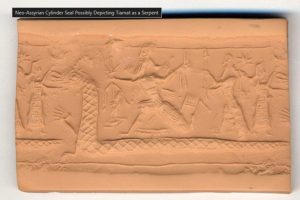
She is depicted, in later periods, as a female serpent or dragon based on vague descriptions of her in Enuma Elish, but no iconography exists from ancient Mesopotamia. Her name, according to scholar Jeremy Black, comes from the word tiamtum, meaning “sea” (Gods, Demons, and Symbols, 177). Although her name is referenced in a much earlier Akkadian inscription, she does not figure in extant Mesopotamian mythological literature until the Enuma Elish, written under the reign of the Babylonian king Hammurabi (1792-1750 BCE) and usually dated to circa 1750 BCE but no doubt written earlier. Later mentions of the goddess are simply copies and variations of this work.
published on 04 May 2020
It has been suggested that Tiamat is the Babylonian version of the Sumerian mother goddess Nammu (also given as Namma), but there are significant differences between the two deities, notably that Nammu is consistently a nurturing, caring figure while Tiamat is vengeful and tempestuous.
In the Enuma Elish, she is defeated by the hero-god Marduk, and some scholars, including Paul Kriwaczek, interpret the poem as a ‘codified’ history of the rise of the male chieftain (known as the lugal, “big man”) in Mesopotamian society. Other scholars (such as Robert Graves) have seen the work as a poetic response to the loss in status of female deities during Hammurabi’s reign when male gods – notably Marduk – superseded them, arguing that the poem is an artistic representation of the rise of a patriarchal religious paradigm over an earlier matriarchal model.
It is more likely, however, that neither of these interpretations is correct or, at least, they do not fully address Tiamat’s character or the central focus of the Enuma Elish. Both interpretations ignore the history of the time the poem was written and fail to fully address the character of Tiamat and how the author of the Enuma Elish draws on the earlier Sumerian goddesses, Nammu and Inanna, to create the goddess of chaos.
Nammu, Inanna, & Tiamat
Nammu is first attested during the Early Dynastic period in Mesopotamia (circa 2900-2350/2334 BCE), specifically the period known as Early Dynastic III (2600-2350 BCE), although she most likely existed in oral form before that. Nammu is described as the “original mother who gave birth to the gods” in the Sumerian poem Enki and Ninmah, but this work has not been definitively dated. Jeremy Black comments:
In Enki and Ninmah, the goddess Ninmah (better known as Ninhursag) and the god of wisdom, Enki, create human beings as helpers for the younger gods who are tired of manual labor and the maintenance of order against the forces of chaos. When the poem begins, the younger gods have been crying out to Enki to help them, but he continues to sleep and does not hear until he is awakened by his mother Nammu, who carries the gods’ tears to him and influences him to do something about the problem.
Unlike Nammu, Inanna was never a mother goddess. Inanna was the Sumerian goddess of fertility, love, procreation, and sensuality, but she was also associated with war, violence, and capriciousness. She was originally a minor vegetative deity who grew so popular that she came to be worshipped throughout Mesopotamia as the Queen of Heaven and is featured in a number of well-known Mesopotamian myths as well as in The Epic of Gilgamesh (written circa 2150-1400 BCE) under her later incarnation as Ishtar.
![Offering to Inanna, Warka Vase [Top Register]](https://www.worldhistory.org/img/r/p/1000x1200/10591.jpg.webp?v=1779613331-1724658887)
In a number of works (Inanna and the Huluppu Tree, Inanna and the God of Wisdom, among others), she is seen as manipulative and devious, primarily interested in getting her own way. She was popularized quite early in Mesopotamian history by the Akkadian priestess and poetess Enheduanna (circa 2300 BCE), daughter of Sargon of Akkad (reign 2334-2279 BCE), founder of the Akkadian Empire, and, by the time of Hammurabi, was the most popular deity in Mesopotamia and patron goddess of the city of Babylon.
Tiamat has been claimed to be the Babylonian version of Nammu, but there is hardly any scholarly consensus on this claim. The only similarity between the two is that both are female, associated with the sea, and feature in stories concerning the creation of the world and humanity. Some scholars have noted that neither goddess had a cult following or temple dedicated to them, but this claim has been challenged by the mention of a shrine to Nammu in Babylon.
The most significant difference between the two is their intrinsic nature: Nammu is a nurturer, while Tiamat’s initial impulse toward caring for others is blunted by her seeming betrayal by her children, and, afterwards, she becomes vengeful and destructive. This latter aspect of Tiamat associates her closely with Inanna, who, especially in The Epic of Gilgamesh as Ishtar, does not take rejection well and is prone to a violent response.
Enuma Elish Summary
The Enuma Elish begins with the creation of the universe, originally an undifferentiated mass of water swirling in chaos. The waters divided into fresh and salt, and the freshwater formed the god Apsu, while the saltwater formed the goddess Tiamat; from their union were born the younger gods. At first, all was well, but the younger gods became increasingly loud and boisterous, upsetting their parents:
The divine brothers came together
Their clamor got loud, throwing Tiamat into a turmoil.
They jarred the nerves of Tiamat
And by their dancing they spread alarm…
(lines 21-24)
Tiamat is angry with them but feels powerless to influence their behavior:
Tiamat was silent when confronted with them.
Their conduct was displeasing to her
Yet though their behavior was not good, she wished to spare them.
(lines 26-28)
Apsu is also irritated by his children’s actions and confers with his vizier Mummu about the problem. They agree nothing can be done until they have spoken with Tiamat, and so they go to her chamber, where Apsu opens the discussion, saying:
“Their behavior has become displeasing to me
And I cannot rest in the day-time or sleep at night.
I will destroy and break up their way of life
That silence may reign and we may sleep.”
When Tiamat heard this
She raged and cried out to her spouse,
She cried in distress, fuming within herself,
She grieved over the plotted evil [saying]
“How can we destroy what we have given birth to?
Though their behavior causes distress, let us tighten discipline graciously.”
(lines 37-46)
Mummu interjects at this point, encouraging Apsu to destroy his children, and Tiamat’s plea is ignored. Apsu and Mummu agree to kill the younger gods, and Tiamat, not knowing what else to do, feels she must warn her children. She goes to the god of wisdom, Ea (also known as Enki), and tells him about the plot.
Ea, in addition to his great wisdom and intellect, was also the god of magic. He puts Apsu to sleep through an incantation, kills him, and then imprisons Mummu. Apsu becomes the freshwater of Ea’s home (associated with the Sumerian city of Eridu elsewhere), and once everything is settled and Ea has established order, he and his wife Damkina live happily, and she gives birth to their son Marduk.